Olaf Lorenz, General Manager DX Branding Division at Konica Minolta Business Solutions Europe, on the profound way the experiences of 2020 are reshaping the future of work in his company and beyond
It is about one year ago – on March 13, 2020, to be precise – that the COVID-19 pandemic forced us to shift the majority of Konica Minolta’s business in Europe to working from home. Countless companies and organisations large and small across the globe had to do the same. If we consider our business work environment as a complex ecosystem, then we can safely say that COVID-19 has ripped a hole through the heart of that ecosystem. It has wreaked havoc on many of our established daily work routines and processes whilst also challenging how we nurture and grow business relationships. This unforgettable year will obviously leave an indelible mark on many communities and families. But it will also change how we live and work forever. It is up to all of us to decide what we learn from this past year and how it will change us as well as what opportunities are available for a different future that exploits everything we have learnt. As in nature, for the inhabitants of an ecosystem, even catastrophic events present opportunities for new, fresh growth. Let us seize these opportunities to shape a work environment that is better than before, across our entire business landscape. What I mean by this goes far beyond settling for more flexible home office agreements. It is time to let go of some long-held beliefs about work and embrace new digital workplace options. We have to truly embrace digital transformation will all its impacts and opportunities.
As soon as it was clear that the local outbreak of the new corona virus would become a global pandemic, all Konica Minolta Business Solutions entities throughout Europe immediately shifted almost all of its operations from the office to home. This move encompassed more than 9,000 employees working across the 30 organisational entities that form the Konica Minolta Europe family. All of this unfolded in just a few days. This was made possible by a huge collaborative effort by all of our employees, but especially those in internal IT, HR, the countless team leads in different departments and a dedicated interdisciplinary coronavirus taskforce we put in place. It is nothing short of impressive, what was achieved at such short notice in so little time and with minimal risk to business continuity for our customers: Internet bandwidth for providing additional capacity for remote work was scaled up from 4 Gbit/s to 12 Gbit/s within two days (11.03.2020 – 13.03.2020) and reached the targeted capacity of 20Gbit/s four days later, on March 17th 2020. Remote working capability via VPN was extended from 1,000 concurrent users to 3,000 concurrent users within three days (5.3.2020 to 8.3.2020) and expanded to a maximum capacity of over 9,000 concurrent users within another 5 days (finished by March 13th) as the IT environment had been designed from the scratch to be agile. During peak times approximately 6,000 users have been working remotely in parallel – all without major issues or disruptions.
.png.aspx?width=400&height=266?auto=webp&resize-filter=bicubic&width=1280)
A preliminary ‘new normal’ fostering openness for a change in work
For Konica Minolta, the months that came after the initial lockdowns were defined by shaping a ‘new normal’ – although even then it was clear that this would only be a preliminary phase. We quickly established new ways of working and new routines. Many of us also had to take on the additional challenge of taking care of our children, as in most countries, schools and day care centres were closed.
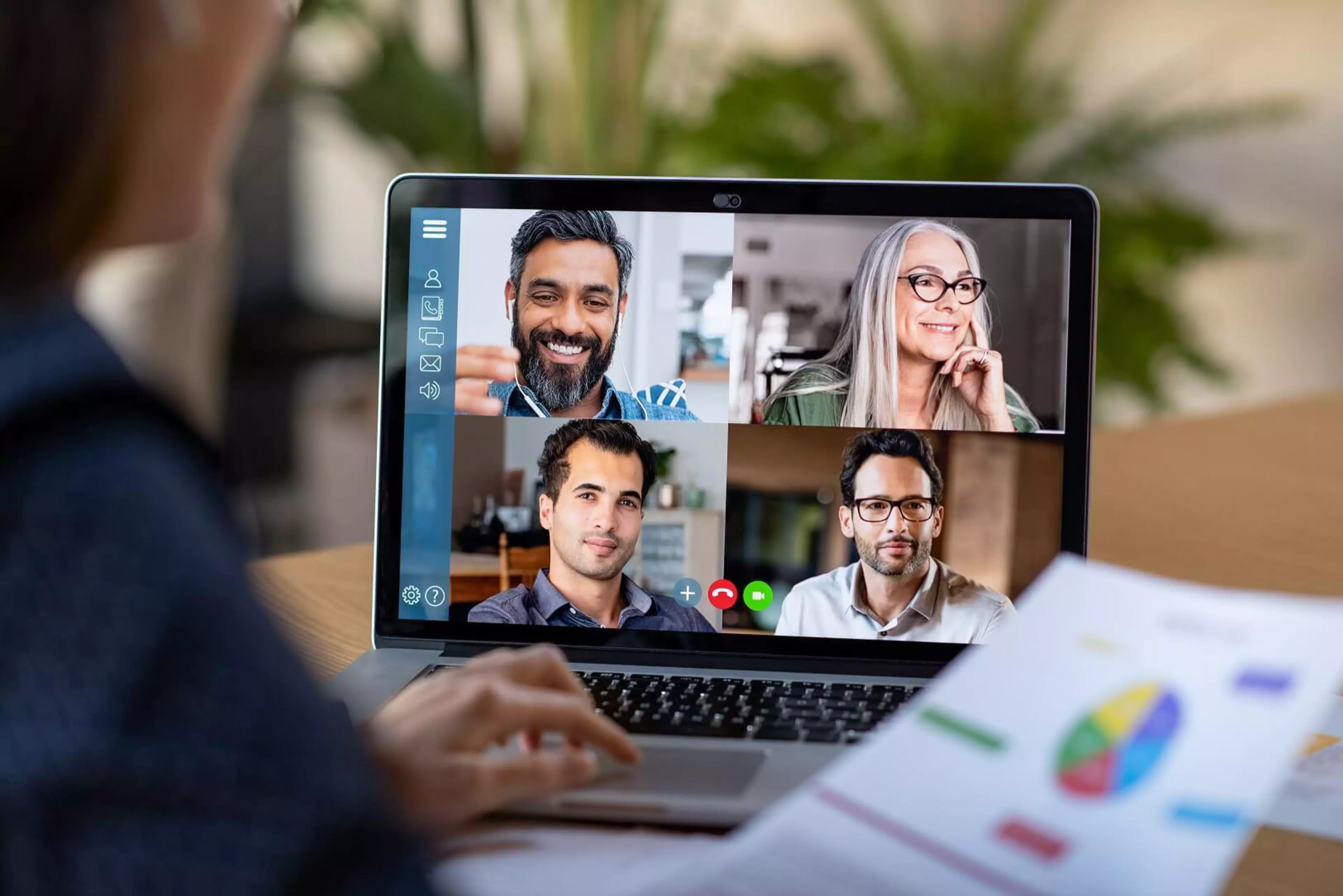
Yet, work continued – despite looking and feeling very different. Teams started to meet virtually and collaborate remotely. Even though we already had good collaboration across teams from different countries, geographical or physical barriers between teams were completely removed and as a result we saw improved collaboration across all teams. The de facto use of new work options that provided a ‘digital backbone’ for our organisation initiated a sweeping cultural change ‘from the bottom up’. A colleague from Business Development, for example, was now just one Microsoft Teams invite away from a Marketing Meeting – and quick to join in. A product launch in Spain could be supported by colleagues in France who had introduced the solution a couple of weeks earlier in their market, and colleagues in Poland could contribute by inviting a customer already using the solution to join the same call. Although this was obviously already possible before, the pandemic broke down some additional boundaries and changed mindsets which ultimately boosted international collaboration even more.
We applied other digital technologies to maintain customer continuity where previously a physical presence had been required. Take customer service for our office print devices, for example. Previously a site visit by a service engineer was required to diagnose and fix faults. Now we can not only assess hardware faults remotely using AIRe Link, our own remote visual support tool, but we can also resolve issues remotely using our remote support platforms. AIRe Link enables support teams to see what their customer sees – from their own home office. This enables them to not only provide customers with support but also ensure a ‘first-time fix’, if a visit is unavoidable. Using this technology is not only faster than face-to-face fixes but is also safer and better for the environment processes. More than 3,800 on-site customer visits which equal 190,000 kilometres of service travel were saved across Europe during the first year piloting AIRe Link. This corresponds to 26.7 tons of CO2 emissions. Some teams took the use of remote technology one step further, using it to carry out remote installations of solutions – devices are now transported to customers pre-configured so once in-situ and connected to our remote support platforms, the solution can be set-up and tested remotely as opposed to an engineer having to be on-site. You could say that left with only digital options to work with, these workplace solutions were able to demonstrate their full potential to us and our customers.

91 percent of the colleagues stated they could see themselves working more from home or adopting mobile working in the future. In fact for many it was the Corona crisis experience that changed their attitude to mobile and remote working. Despite the sudden and ad-hoc nature of the transition, 60 percent were completely happy with the availability and efficiency of the systems and a further 34 percent were satisfied in general. What was particularly good to see was that teamwork received the best feedback: 65 percent gave reachability of the colleagues the best rating with an additional 25 percent satisfied overall. Remote team interaction and collaboration worked. What was frankly surprising, was the level of openness we saw towards introducing a shared desk policy, with 70 percent of our employees regarding this idea favourably.
Utilising MS Teams platforms, our colleagues in the UK created on-line engagement activities that would otherwise take place if people were together, such as tea/coffee room roulette which takes a random three colleagues and gives them a designated coffee break where they can talk about anything, providing a substitute for the accidental conversations one might have in the kitchen in the office.

Laying the foundation for new work and workplaces
What we saw in this time period was nothing short of a complete mind shift in terms of how we work, a complete cultural change. To those of us on the European Management Board, it was clear that we would need to cater for these new expectations and seize this opportunity in terms of retaining and attracting new talent. We must also not forget that while the pandemic may have put long-term development projects on hold for the time being, these will return to the agenda in its aftermath. Take the continuing skilled labour shortage, particularly in IT, for example. Or Generation Z employees looking to a better work life balance. Both examples call for a new way of working to maintain our position as a Top Employer.
First and foremost, we fundamentally revised our remote work policy – and inseparably, and arguably more profoundly, our management culture. While many colleagues previously had the option to work occasionally from home, we wanted to provide them with the flexibility to work wherever was best for them – based on their own judgement and personal experience. The flexibility to decide whether or not to work remotely on any day is not a privilege anymore – it is a given. Personal presence in the office can only be requested if there is a clear need and value associated with that presence. In any other situation the decision can now be left to the individual. Because, in the end, what counts is what each of us achieve in our working day, not where or when we do it. In some cases this may well be the office, in others it may be at home, or at a customer’s office, or a supplier’s location, or in a café – and so on. Of course, everyone will be welcome in the office when it is safe to be there – be it for socialising with colleagues, creative work, innovation sessions, and so on. By flexing our policies and culture we can accommodate personal preferences.

By now it is clear that there is no way to return to our pre-pandemic ways of working. Nor would we want to – we have all learnt so much first-hand about the opportunities new digital working practices can provide. With all the challenges we have faced, and we’re still facing, we all have the opportunity to reshape the ecosystems we work in to better suit our needs. Although the solutions for true digital working were already available to our teams, the actual fully-fledged application of these digital workplace solutions has kicked off a profound digital transformation in our business. For us, this means nothing short of a complete change in the way we work – not just to prevail in the ongoing pandemic, but as a catalyst for an even better way of working going forward. One that nurtures our success in the future as well as helping us meet all the challenges that lay ahead.
About the author
As General Manager, Olaf Lorenz is responsible for the International Marketing Division of Konica Minolta Business Solutions Europe GmbH. Lorenz further is a member of the European Management Board of Konica Minolta. He is responsible for the company’s product lifecycles, from product planning to European launch to the end of the product’s life. Leading the company’s DX Branding Division, he has a strong focus on customer solutions for digital workplace transformation.